


Photo (L to R): Andrew Iwaskiewicz, Carrie Moore, Karen Dyer, Monica Nachemja-Bunton (author), Dane VanNosdeln

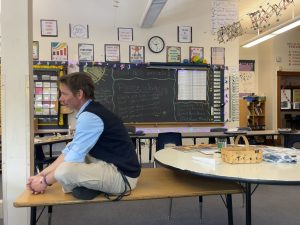 “Ready! Steady! Spaghetti!” Andrew Iwaskiewicz (TIP ‘25), better known to students and faculty as Mr. I, says to his 5th grade class. They are gathered around a small rug surrounded by bookshelves in the back corner of the classroom. Most students are on the perimeter of the rug, with a handful sitting in chairs they’ve pulled up after finishing their breakfast. The large windows framed by beautiful dark wood look out over the town of Johnson, VT and in the distance, Mount Mansfield. Before opening the floor, Andrew invited students to think about anything they would want to share with the class that would help them succeed as they moved through the day. He asked them for grace and thanked them for their flexibility, a standard refrain in his communication with students. And while some students shared that they were tired, others opened up about some struggles they were having at home or in school the previous day. Mr. I asked them what they would need from others that day, and their peers eagerly agreed to meet these needs.
This calm, inviting nature, setting students up to be heard and fully seen by their classmates, supporting them in facilitating their own learning and discussions, going deep on content as well as connections with each other, has been a staple in Andrew’s room since I first visited him in the fall of 2024, when he was just beginning his UVEI journey via the Teacher Intern Program. My visit to Johnson Elementary School this spring was prompted by a desire to visit four alums: Andrew, second grade teacher Karen Dyer (TIP ‘23, MEd ‘24), and first grade teacher Carrie Moore (TIP ‘22) as well as their new principal, Dane VanNosdeln (PIP ‘24).
I spent a full day at Johnson, immersed in the culture of the school and getting familiar with some of the changes Dane has brought in, as well as his and others’ vision for what comes next. This vision is grounded in a number of principles: “open collegiality” and classrooms without walls, where colleagues share their instructional practices with each other and model the vulnerability that is opening your classroom door and space to someone else. Teachers’ voice in decision making and the focusing direction for the school is top priority for Dane, which shapes the school’s student-centered principles: continuing to build on their strength in relationships and belonging; growing community connections and trauma-informed practices for supporting students and their teachers in moments of dysregulation; and finally, grounding in strong instructional practices to ensure academic growth for all students.
CATALYST FOR CHANGE
These focus areas did not happen by accident, nor were they determined by Dane or the rest of the leadership team. When the school year started, staff worked through a number of protocols, such as Stop Light and Chalk Talk, beginning with the school’s instructional framework and slowly narrowing down to a set of year-long priorities. Leaders and faculty worked to identify teacher practice, student practice, primary and secondary drivers, as well as questions they had about the elements in the framework. Dane met with teachers one on one as well, getting more input as they drilled down.
When thinking about UVEI’s How Schools Improve Conceptual Framework and how leaders can become a catalyst for change, Dane is exemplifying in this process what it means to lead the conversation through listening and dialogue. Through this process, he is leading the conversation while not taking it over, focusing the work on the core business of teaching and learning, and leading school improvement as a collective effort, all areas of school improvement gleaned from his time in the Principal Intern Program. Teachers are a pivotal part of school-wide goal setting, establishing ownership over the process and outcomes.
Dane is exemplifying in this process what it means to lead the conversation through listening and dialogue.
The plan for next year pushes the process to the next phase. Dane shared that the leadership team will form a Core Learning Group. Based on the outcomes of the goal-setting process this year, teachers will choose their Professional Learning Community (PLC) topic of choice from a menu, and each PLC will also have a choice in how they learn. This could be instructional or peer coaching, traditional workshop style sessions, reading a book together, or some combination. The aim will be to share and acquire best practices, with immediate application of new skills and practices. Teachers will engage in cycles of learn, do, reflect. When considering how schools improve, this demonstrates capacity building, shared leadership, and mutual engagement. Teachers are not passive recipients of new knowledge; rather they are helping determine the direction their collective work takes.
JOY AND RIGOR
 Andrew, Karen, and Carrie join Dane and I for lunch. Our conversation swirls around how difficult it is to be an educator, and at Johnson, how some of the behaviors can make it hard to get to academics in the way they want to. They know that a lot of students come to school experiencing the impact of different trauma. When I ask why they stay in it, what brings them joy, they all say the same thing: the kids. Seeing a student do something today that they couldn’t do yesterday, the growth over time, small moments of victory – this is what keeps these teachers going.
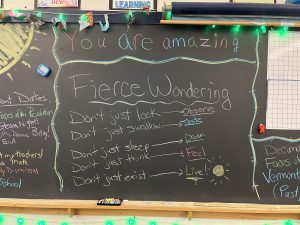
Back in the classrooms, between mandated testing there is joy and rigor. What looks like a silly game in Carrie’s first grade classroom is building their counting skills as well as their ability to focus for an extended period of time. Students become leaders as they demonstrate different ways to count and model the number of the day. Carrie deftly prompts deeper thinking with questions such as “When there’s a lot of them, what do we count by?” and “When we have a countdown, do our numbers get bigger or smaller?” As each student sits back down, she asks the class to show them some appreciation.
Seeing a student do something today that they couldn’t do yesterday, the growth over time, small moments of victory – this is what keeps these teachers going.
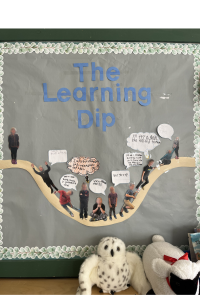 In Karen’s room, students are scattered about reading to themselves as she conducts a comprehension assessment with one of her students. I sit next to a student in a rocking chair near the board. She tells me exactly which bin she chooses her books out of, and as we are reading I observe her decoding familiar phonics patterns. When she gets stuck on a word, she persists through it, then goes back to the beginning to reread the whole phrase or sentence. Later in the day, I stop by again and see Karen sitting outside speaking with a student who was having a hard time. She is calm but firm, asking about why it happened and what they can do to address it, modeling premises of restorative and trauma-informed practices. Inside her para is running a UFLI phonics lesson where students are encoding words that end in the suffix –es, prompting them to consider the doubling rule in some cases.
Andrew leads his students in a number of games that promote collective problem solving, team work, and working memory around math. Closing circle is shortened today. Usually there is time to share an Aha! moment from the day, but that afternoon there was a fire drill and a debrief is in order. But there is always time for the other As: first Acknowledgements, where students can share something they saw a peer doing that exemplified the class’s values, or was just plain kind. Then Apologies, in case there was a minor disagreement or harm that someone wants to acknowledge so it doesn’t fester and grow into something larger. Finally, students stand up and put their hands in the center of the circle. As they lower their hands together, and then slowly lift them towards the ceiling, they say in unison and with a well-practiced timbre: ¡Aaaadiiiioooooos!
Monica Nachemja-Bunton is a faculty member in UVEI’s Teaching, Literacy, and Leadership Programs. She was Andrew’s faculty coach last year when he completed the Teacher Intern Program, and she is thrilled to see the work that these educators are doing at Johnson Elementary School.
