


Beyond Community Service: Citizenship at the Heart of the Curriculum
This was the title of a workshop that Elijah Hawkes, UVEI’s Director of School Leadership Programs, facilitated at the Rowland Foundation’s Annual Conference on October 30 at UVM. As the UVEI registrar, a former math teacher, and a middle school parent, I am always interested in how education is evolving and innovating, so I asked Elijah to tell me more about his workshop! He started by sharing his slides with me – slides that wove together the needs of students to be citizens of a wider society and the learning that takes place in school. I was intrigued, so I followed up with some questions.
Our Dialogue
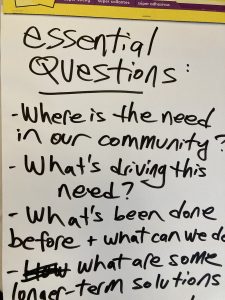 Early on in the workshop, you describe the three overarching developmental needs of young people:
To do work that needs doing in the place where I live
To do work with tools suited to the task and to my capacity to wield them
To do work with/for people I care about
Can you give an example of how this could play out in, say, a middle school math classroom or a high school English classroom?
Rethinking Schools has an example from a math class that I would recommend looking at. It’s a detailed lesson reflection from a math teacher, who writes, “Unlike the graphs readily available in textbooks, the solar graphs we’ve just explored allowed us to deepen our understanding of solar energy production, learn how effective it is in New York, and engage with the very real potential for a change in how our energy is produced.”
In a high school English classroom where students are reading and writing in a variety of forms, learning how to write letters to the editor of local or state newspapers and online publications is one way that students can be taught to use their skills to shape local perceptions and local policy dialogue.
Often, doing this kind of work in isolation (as one ELA teacher or one math teacher) can limit the scope of the work. Doing work in collaboration with other teachers can expand the possibilities. For instance, if students were learning in science about solar power in the local community, and learning in math how to graph and learn from graphs, and learning in English how to write letters about local solar power zoning policies, then these teachers, together, can help students do work that needs doing in the place where they live.
I need… to do work that needs doing in the place where I live, to do work with tools suited to the task and to my capacity to wield them, and to do work with/for people I care about.
I can imagine that spending even half of your school day on something like this, rather than just a small time block, would be a more active and engaging experience. And while engagement can take many forms, I think you’re talking here about application of learning as an active participant in society. You actually discussed a gap between abstraction (common in schools) and application and gave some examples of mindset shifts that can bring educators and students closer to active, applied learning. Somewhat subtle shifts such as from “guest” to “partner”, from “field trip” to “field work”, and from “audience” to “consumer” seem to embody a relevance and a level of engagement that moves beyond the abstraction that most of us have come to expect from learning activities.
Ultimately, I can see that the goal is to move away from isolated “service projects” and into “citizenship” where the work students are doing is necessary and relevant, the learning takes place beyond the walls of a classroom and students, teachers, and community members are all active partners in the work. What is your advice to educators who love this vision but don’t know how to get started?
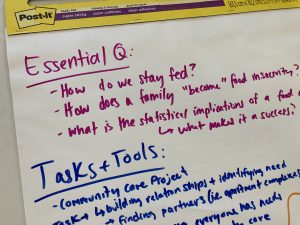 One way to start is to begin in the place where you are with students most of the time: your classroom, your school. What work needs doing in the classroom? What problems need solving? What are the needs in the school that we might help address? Responding to any of these questions will lead to the need to develop certain skills and apply them.
It’s also fun to explore what’s out there and what other people have created and are offering us to learn from. While I don’t endorse every resource that someone will find there, a bunch of national websites and resources I often share with folks are:
- Resources from an elementary school teacher, Jess Lifshitz: “Crawling out of the classroom.” (Scroll ALL the way down for tags/links to specific topics.)
- A recent book by Liz Kleinrock, Start Here, Start Now: A Guide to Antibias and Antiracist Work in Your School Community. You can download and read a sample at this link.
- Resources from various school/curriculum reform organizations:
Somewhat subtle shifts such as from “guest” to “partner”, from “field trip” to “field work”, and from “audience” to “consumer” seem to embody a relevance and a level of engagement that moves beyond the abstraction that most of us have come to expect from learning activities.
We’re fortunate to have a lot of good ideas out there, and I know that everyone’s personal experiences and particular school setting also come into play when designing and implementing curriculum. Your workshop had about 100 participants last week – school leaders, teachers, and even some students. As they return to their daily work in their schools and districts, what ongoing supports will they need if they are to move towards this vision of “citizenship at the heart of the curriculum.” Where will this support come from?
I was delighted to see that a lot of people in the room were there with colleagues from their schools. These folks will be supporting each other, I hope, with this work. That’s the best kind of support: collaborating with colleagues with whom there is a shared sense of purpose. Teachers can also start with the standards in their disciplines and plan from those as a point of departure. This might help teachers feel “supported” by the expectations that guide our curriculum design. In my presentation I shared a couple including:
- Common Core Math: students “model with mathematics; eg: “proportional reasoning to plan a school event or analyze a problem in the community.”
- C3 Social Studies, Gr 2: “identify ways to take action to help address local, regional, and global problems.”
In addition, I always give my contact info and let folks know about our work at UVEI as well as other workshops I lead so that they know I am – and we are – always a resource to them!
That’s the best kind of support: collaborating with colleagues with whom there is a shared sense of purpose.
In Closing
Elijah and I are hopeful that this reaches some educators across the UVEI network and provides a spark for moving towards a vision of citizenship that is truly embedded in a meaningful curriculum. Please reach out to Elijah if you have additional questions or would like a thought partner for this work. ehawkes@uvei.edu.
The views and/or recommendations expressed in this piece reflect the professional judgment, expertise, and perspective of the author(s), and not necessarily those of UVEI as an institution. UVEI publishes material consistent with our policy of institutional restraint.
