


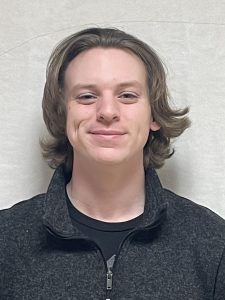
 “As the paraprofessional, working one on one, it was great, but I really only got to see a handful of students,” says Alex St. Martin (TIP ‘26, MEd ‘27), who is now a fifth grade teacher at Indian River School in Canaan, NH. He says the times when he was able to take a substitute role, or walk around the room and see what all the other kids were doing, and how they were all different, was really compelling. He wanted more of it.
Now, as a first year teacher working towards elementary certification at UVEI, he says he has the privilege of giving each of his students his full attention. “It’s amazing to see the cogs in their brains turning as they’re going through a problem. There may be something that a month ago they couldn’t get to, and now they can tackle that. Seeing that progress is great.”
Learning to Teach
“At UVEI, so much of the credit hours is doing the thing, then learning how to reflect on the thing, then doing it again,” which he says would not have given him the same preparation as a traditional program.
The coaching he’s received through the Teacher Internship Program has been a crucial part of his growth. “When we had my first observation and the meeting after, we talked about all the things I can try and do; then I did them. It was eye opening. I was able to see actual teacher examples of things to do in the classroom. So helpful.” Reading the research behind the strategies has also made a huge impact on his reflection and practice. He is able to connect to the why and this gives him even more confidence that he can implement them.
“…we talked about all the things I can try and do; then I did them. It was eye opening.”
And these small shifts have made a difference. As he’s chunked out his lessons and implemented more structured transitions, he sees that his students who need that are able to grow and thrive. “If I had kept things rocky, they wouldn’t have that space to learn effectively. That child is a different child than they were the first week of school.” He’s given students the space to be their best selves.
Teaching to Learn
As his coach, it is always exciting to visit his classroom, and I often learn something new. His students are eager to share what they are learning, coming up to me almost as soon as I walk in and before I have a chance to even take off my coat. One day students were sticking slips of paper into water. I asked a couple of students what they were doing, and they told me it was to help them understand how atoms move. Later, Alex explained to me that “since we can’t actually see atoms or molecules (who knew!), we spend a lot of time learning how and why scientists use models to show information we can’t observe directly. We focus on what a model is, why it’s useful, how to read one, and how to create one of our own. The first chapter [of the science text] centers on this idea and uses paper chromatography [a method for using paper to separate a colored substance – students can watch different colors climb up the paper!] as the backbone for practicing these skills.” This method allows students to observe phenomena that would otherwise be invisible. “Students can actually see molecules in action and then create models to represent what those molecules are doing.”
“…they surprise me every day and continually show that they’re capable of understanding very complex ideas.”
Once they wrapped their heads around this, the class moved on to comparing levels of attraction between different solids and liquids. “Honestly, it still blows my mind that 5th graders are learning these concepts, but they surprise me every day and continually show that they’re capable of understanding very complex ideas.”
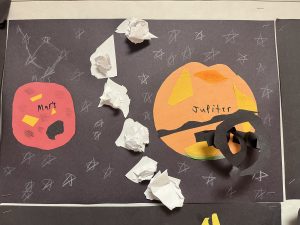
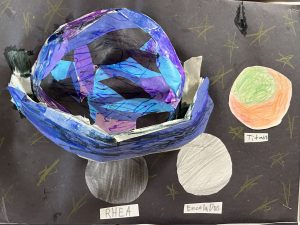
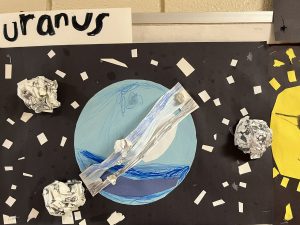
Another day they were practicing reading a familiar passage with “emphasis” – giving each other feedback about how it supported their comprehension, using a graphic organizer to support their thinking. They were proud to show me their 3D models of the different planets which were displayed on the bulletin board in the hallway.
Alex has incorporated table top games into his transitions for students, and into his instruction. In a twist I never saw coming, his students were assigned to design and then create a game about morphology: root words, suffixes, and prefixes. They could choose to work alone or in pairs, and used a graphic organizer to think through the goal of the game, how to win, what a turn looked like, and what materials would be necessary to construct it. As students were considering these aspects and more, they were consulting their notebooks where they had gathered their learning about the meanings of several affixes.
That’s not to say it’s all easy. It has taken him a while to get used to the demanding schedule. And no one told him how many emails he’d have to write! But, “I’m going to work every single day and what I’m doing every day matters to these 10 lives. I feel that impact. When they come up to me and want to tell me about their weekend, I love that they thought of telling me about this cool thing that’s important to them.”
Monica Nachemja-Bunton is a faculty member in UVEI’s Teacher Intern Program who coaches elementary teacher candidates. Monica can be reached at mnachemja-bunton@uvei.edu.
