


A visit to an engaging 6th grade classroom uncovers a collaborative effort to center student-focused inquiry in science classrooms at LMS.
By Marie McCormick & Page Tompkins
It was the promise of deeper learning and chocolate chip cookies that brought us here. As the parent of a sixth grade student at Lebanon Middle School, I [Marie] was captivated by the unit plan that Kristen Rzemien, 6th grade science teacher, presented on parents night. Students would be answering the question of how the ingredients in chocolate chip cookies turn into the cookies themselves, and in the process would be learning about matter and energy. This – both the topic and the teaching method – was something that we wanted to know more about! Fast forward one month, and Page Tompkins and I visited Kristen’s classroom to watch one of her science classes in action.
We had learned by now that Kristen was a veteran educator with ten years of teaching experience at LMS and was an environmental educator at VINS before coming to LMS. Although she had done an essential-question-driven unit in the past (“Can black bears survive in Lebanon?” for life sciences) the use of anchor questions to drive every unit was something she was trying for the first time. Her participation in a structured cohort of fellow LMS colleagues (facilitated by Two Revolutions) provided her inspiration, and ensured she was not doing this work alone – in fact, she credited the support of these colleagues for her willingness to take the risk of going “all in” on this type of teaching this year!
Inquiry in Action:
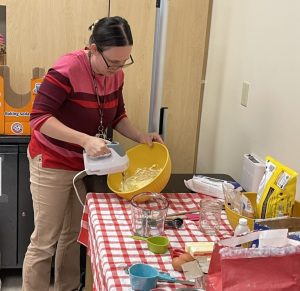 Classes were nearing the conclusion of the cookies (matter and energy) unit. The anchor question: Why do cookies change when they bake? The scientific concepts: differences between matter and energy, neither matter nor energy can be created or destroyed, and heat (baking) is a form of energy.* On this particular day, the class was going through each individual cookie ingredient, working together to explain “What happens to that ingredient as it goes into the dough and gets baked?” A successful answer meant that the ingredient would be added to the dough that would be baked the next day for a class treat. Here are some of our key takeaways:
Routines were evident from the start to end of class: preparing the necessary materials for the day, making eye contact with the person speaking, and following norms and prompts* for “academic discussions” in groups and with the whole class. At some point, a call-and-response of “Don’t try to give your papers to me, because I am…”A black hole!” caused us all to chuckle. These routines clearly reduced the cognitive load on students, allowing them to quickly move into deeper learning activities.
Kristen anchored the lesson continually, using charts on the walls and verbal reminders to connect the original question, the student-generated sub questions, and the experiments that students had performed during the unit.
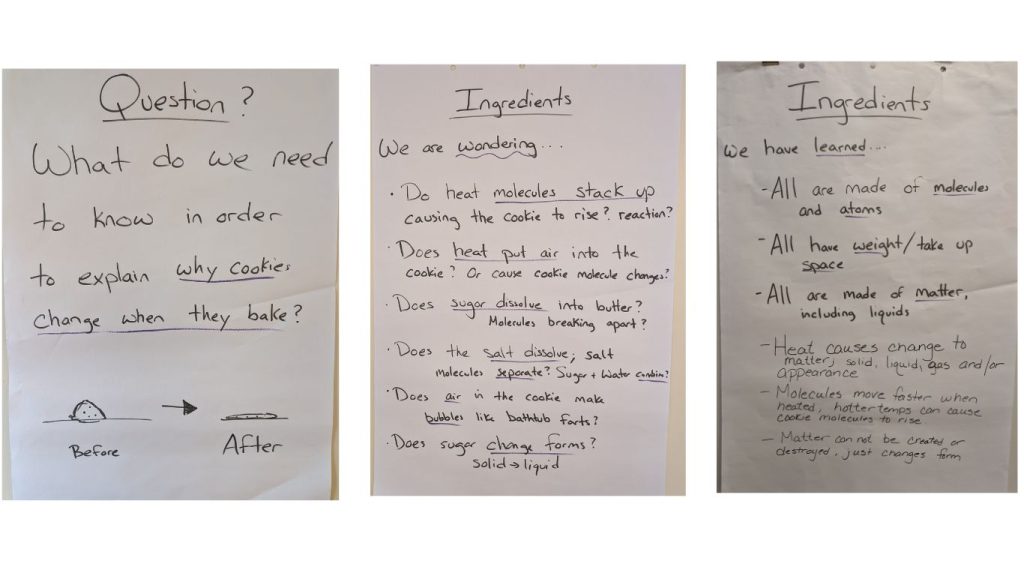
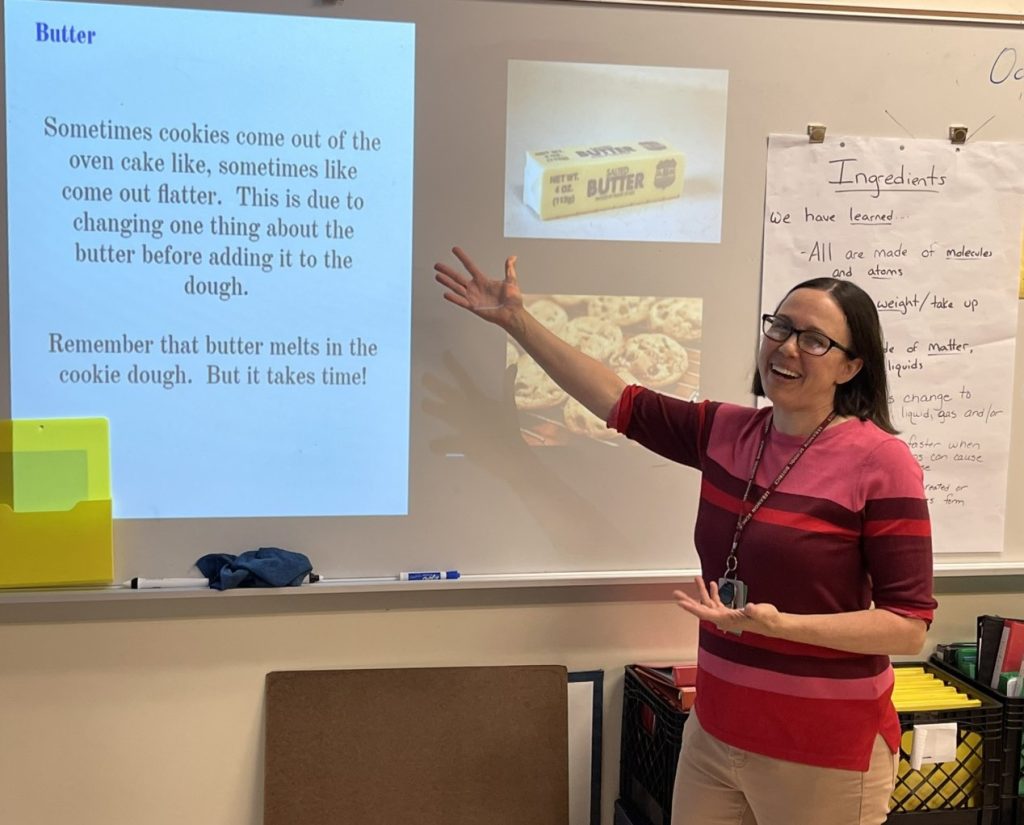
An atmosphere of inquiry, respect and risk taking had been cultivated in the group. The day wrapped up with a brand new question: how does the butter affect the shape of the cookies? An academic discussion closed the day, during which Kristen reminded the class about wait time and eye contact, but otherwise let the students direct the conversation with statements such as “I agree with what you said, and I would like to add…” and “I heard you say…and I wonder…” Students drew on the unit and also on personal experiences. Not having a definitive answer was ok, and students knew that the baking of the cookies would give them some more evidence to help them understand what was going on.
Reflecting on the unit:
Following the end of the class, we talked with Kristen about how things were going. She was pleased with the results so far, and pointed out that “This is much more about ‘you show me’ [student shows teacher] rather than ‘I show you’ [teacher shows student]. Students are spending more time collaborating, talking to each other, and generating questions.” In other words, students were deepening their learning and developing transferable skills.
No aspect of teaching is without its challenges, and Kristen continued to grapple with some of these as she reflected on this unit. Namely, “Students are collaborating all the time, which is a success. But I still need to incorporate some individual accountability and assessment, so I’m working on ways to transition smoothly between group and individual.” Time was also a question – unsurprisingly, this type of teaching meant that the same amount of material was taking a bit more time to get through. Once again there was a question of balance and the creative tension between breadth and depth when thinking about science instruction over the course of a year.
One classroom, part of a larger effort:
Knowing the importance of collaboration to Kristen’s work this year, we checked in with a couple of the collaborating science teachers at LMS. Kate Davis (Barnes Initiative ‘25) teaches 8th grade science and agrees that this work relates to key transferable skills. “We were reminded that there is a need to explicitly teach skills such as generating meaningful questions, appropriately engaging in discussions with peers and using evidence to back up scientific claims.” On the importance of collaboration, Kate points out that “Being part of this group enabled us to try new strategies. We benefited from seeing the shared challenges across different subject areas and grade levels.” Through her work in the Barnes Initiative this year, Kate is investigating equity centered deeper learning together with educators across the region, and the relevance is clear. “I like using the framework of inquiry-based learning in my classroom to create an environment where all students feel supported, challenged and capable of being successful in science.”
Kate gave us an 8th grade level example of this inquiry-based learning: one unit on matter started out with students watching a dramatic video of a collapsing train car and trying to explain what was going on. It continued with students performing related tests and experiments and using what they learned to refine their explanations, and culminated with students using air pressure to crush a soda can and explain how it was happening. In 7th grade, Beth Gagne (TIP ‘08) and Erin Sturtz used viruses to anchor a portion of a life sciences unit; having students use a research article to become experts in different aspects of viruses, then come together to share their knowledge and make a claim about whether not a virus is “alive”. Regarding assessment, Kate points out that “Several of us are wanting to incorporate varied assessments and offer students more choice in terms of how they demonstrate their learning.” One possibility being discussed at the 7th/8th grade level: having students plan out the ingredients, recipes, and menus for a TV baking show – using the chemical and physical properties of matter. (I wonder if any of these could also include chocolate chip cookies!)
What’s next:
As we write this, LMS is wrapping up their first trimester and Kristen Rzemien’s class is nearing completion of a unit on “Newton’s Laws” through the lens of dropping a cell phone, or “Why do some things break and others don’t?” Students rave about the class – mainly how fun and energetic the teaching is. They also have some takeaways from the unit, including the facts that “every action has an equal and opposite reaction” and “friction changes the way objects slide on a table”. Marie even caught her son, recently, examining her cell phone case, turning it slowly and taking in all the details. As students hone their observational skills, generate questions, and test hypotheses, it is clear that they are acting as scientists. If their current enthusiasm for science is any indication of their future plans, they will be using these skills for years: both in school and beyond!
*Kristen has made use of external resources in her lesson planning and classroom planning. For the matter and energy unit, she adapted many of her activities from the “Chemical Kitchen” storyline framework designed by Nicole VanTassel at iexplorescience.com. Discussion norms (for scientific talk) that she uses in her classroom came from a conference “many years ago” and she has sense added some specific prompts of her own to these norms.
